
Your organization has approved AI commerce investments for 2026. Maybe AI search. Maybe personalization. Maybe agentic buying or marketplace expansion.
Those investments are going to underperform against their business cases. Not all of them. But most of them. And for the same reason.
Not the technology. Not the team. Not the platform decision. The sequence. And specifically, one hidden assumption buried in that sequence that nobody is questioning at the executive investment level before the budget gets approved.
This is not an implementation problem. It is an executive investment sequencing problem. And the organizations that recognize it before the next budget cycle will have a compounding advantage over the ones that discover it post-launch.
Why your previous roadmap was correct
Before we get to what is wrong, it is worth saying what was right. Commerce leaders who built the previous generation of investments did not make poor decisions. Their sequencing was correct for the era they were operating in.
The previous model worked because humans were making buying decisions. Search engines matched keywords. Product pages carried the persuasion burden. Optimize the page, improve the keywords, convert the buyer. That worked.
It worked because the rules of the game were consistent:
- Humans evaluated products. They searched, browsed, compared, and decided. If data was missing, they inferred or asked.
- Search engines found based on keywords. Match the query to the content. Relevance was a function of terms.
- Product pages carried the burden. Design, copy, and UX converted the human who arrived.
Those rules changed. It is not that the previous generation made wrong decisions. It is that they are now playing a different game with the same playbook.
The rules changed: AI evaluates. Machines recommend. Data becomes infrastructure. The catalog that was a content asset is now a knowledge system that machine decision systems read before humans do.
Search engines asked: Can I find it? AI asks: Should I recommend it? Those aren’t the same question. One rewards keywords. The other rewards evidence.
The assumption nobody is questioning
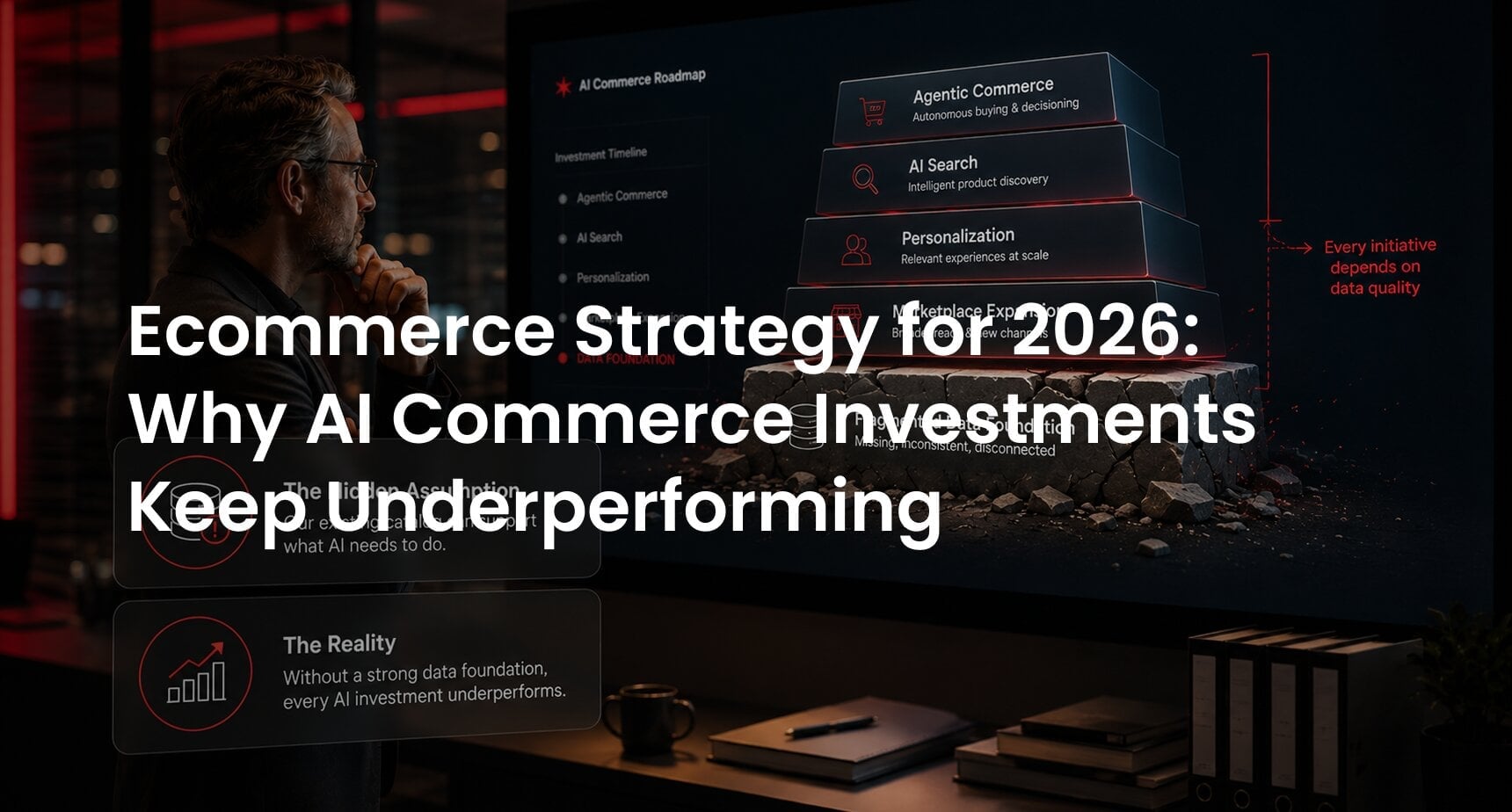
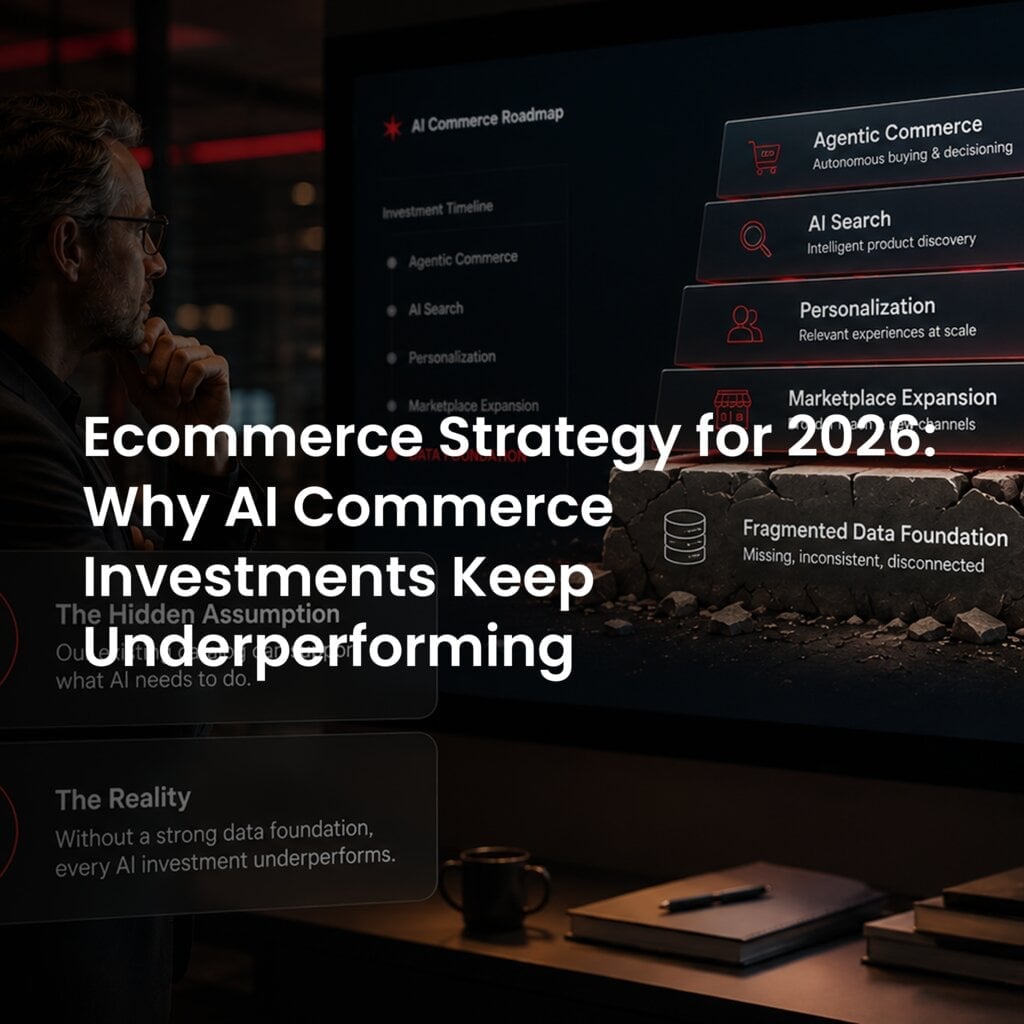
Underneath most 2026 AI commerce investments is a hidden assumption that is almost never made explicit: our existing catalog can support what we are asking AI to do with it.
That assumption is wrong in a specific and expensive way.
Connecting a catalog to an AI system does not make it AI-ready. It makes it AI-accessible. Accessibility and readiness are not the same thing. The AI can read the catalog. Whether what it reads supports confident machine evaluation and recommendation is a different question entirely.
Gartner projects that by 2028, agentic AI will autonomously handle 15% of day-to-day work decisions — a category that includes purchasing and procurement. The organizations whose product data cannot support that evaluation will not be discovered by these systems.
Most organizations begin evaluating AI platforms before validating whether their commerce architecture can support them. That sequencing error is what produces the gap between business cases and results.
Why this keeps happening: the ownership problem
AI commerce initiatives frequently expose an organizational problem that existed long before the AI decision was made: product data ownership is fragmented.
In most organizations, product information is split across merchandising, marketing, ecommerce, product management, and IT. Each team maintains a piece of the catalog. None of them owns the whole thing. There is no single point of accountability for data quality, consistency, or governance.
When an AI system reads that catalog, it encounters the aggregate of every team’s data practices. The inconsistencies, gaps, and conflicts are invisible in a human browsing experience. They are immediately visible to machine evaluation.
Successful organizations establish clear ownership before implementation begins. The AI initiative is not the place to discover that nobody owns the data.
What the wrong 2026 roadmap looks like
The sequence most organizations are running:
- Platform migration — moving inconsistent data from one system to another. Business consequence: higher migration costs, no improvement in data quality, same AI performance gap on the new platform.
- AI search integration — connecting a catalog with incomplete structured data. Business consequence: lower recommendation confidence, products missing from AI-generated results, underperformance against traffic projections.
- Personalization engine — attempting to surface relevant alternatives without relational product data. Business consequence: poor relevance, lower engagement, personalization that recommends the same product the buyer already has.
- Marketplace expansion — feeding inconsistent taxonomy to platforms with strict data requirements. Business consequence: listing errors, suppressed visibility, inconsistent catalog performance.
- Agentic commerce pilot — giving an autonomous buying system incomplete product knowledge. Business consequence: wrong recommendations stated with full AI confidence, returns, compliance exposure.
The technology decisions in that roadmap may be correct. The sequence is wrong. Every initiative is dependent on a data foundation that the roadmap does not include building first.
What the right roadmap looks like
The sequence that produces AI commerce performance:
- Commerce readiness assessment — covering data completeness, taxonomy quality, attribute governance, ownership clarity, change management processes, compliance readiness, and integration readiness.
- Data remediation plan — with ownership, timeline, and budget. Not a content project. A data architecture project with a named accountable team.
- Governance framework — how does product knowledge get created, maintained, and updated as the catalog evolves? This is the difference between a one-time fix and a durable capability.
- Then: platform and AI tool selection — informed by what your data can support and what it requires.
- Then: integration and go-live — on a data foundation that can actually support the business case.
We do not sell catalog audits. We sell commerce systems consulting. The difference is that we are not looking only at whether your data is complete. We are looking at whether your organization has the capability, governance, and architecture to keep it complete as your commerce operation grows.
It is not glasses. It is LASIK. We are not managing a symptom. We are building the infrastructure that makes the symptom go away and stay gone.
The investment multiplier
Every 2026 AI commerce investment your organization has approved — AI search, personalization, marketplace, agentic, syndication — performs better when the data foundation is correct. Not somewhat better. Substantially better, because the gap between what the business case assumed and what incomplete data delivers is large.
Merchandising efficiency improves directly when product knowledge is structured and complete. Filter performance, related-product modules, and category organization all run on the same structured data that AI evaluation requires.
Operational consistency improves when a single authoritative data source replaces the fragmented tribal knowledge spread across merchandising, marketing, and IT.
Customer experience improves when product data is complete enough to power accurate search results, working filters, and relevant recommendations — not just AI systems, but the entire front-end commerce experience.
This is not an argument to spend money on data instead of AI. It is an argument that the data investment protects and multiplies every other investment you have already made.
You have already spent on the platform. On the integration. On the team. On the AI tools. The data foundation is what determines whether all of that spending returns what the business case projected.
Forrester projects US B2B ecommerce will reach $3 trillion by 2027 with AI-assisted procurement becoming standard in manufacturing and distribution. The organizations whose product data is not ready for machine evaluation will not participate in that growth.
The question every 2026 roadmap should answer first
Not: which AI platform should we select?
Not: how do we move faster than our competitors?
The question is: does our product data support the AI investments we are planning? And if not, what does it take to fix that before we spend the rest of the budget on tools that will underperform because of it?