



For direct-to-consumer (DTC) brands and enterprise retail catalogs, paid ad spend is often the primary lever for rapid scale. In the regulated 2A space, however, that playbook comes with a severe structural bottleneck.
Running a multi-million-dollar catalog while navigating strict platform policies on Google, Meta, and major programmatic networks requires constant vigilance. One automated review flag can freeze an ad account overnight, halting customer acquisition and wiping out pipeline momentum.
Navigating the landscape of firearms advertising requires more than quick workarounds or temporary burner ad accounts. Building a resilient 2a marketing strategy demands an understanding of platform policies, combined with a dominant, high-performing organic search foundation.
The Reality of Mainstream Ad Platforms for 2A Retailers
Managing search visibility for complex catalogs requires an architecture that can support high SKU volume and indexation challenges. Implementing specialized seo for firearm websites involves optimizing several core technical areas:
| Platform / Channel | Policy Scope & Operational Impact |
|---|---|
| Google Ads Policy | Prohibits firearms, functional parts, ammunition, and silencers. Strict limits on scopes, holsters, and tactical gear. |
| Meta Ads Policy | Complete ban on firearm sales, weapon ads, ammo, and weapon accessories. |
|
Organic Search (SEO Foundation) | 100% compliant, high-intent traffic, and sustainable revenue independent of platform bans. |
Understanding the precise boundaries of each channel helps protect your domain while identifying where to direct marketing capital.
1. Navigating Google Ads Firearms Policy
Under the google ads firearms policy, paid placements for functional firearms, ammunition, suppressors, and core firearm components (such as receivers, barrels, and conversion kits) are strictly prohibited.
While non-lethal accessories, specialized hunting optics, cleaning kits, and general apparel may technically qualify under standard search campaigns, automated algorithmic sweeps frequently flag destination URLs if related regulated inventory is linked in the navigation, footer, or cross-sells. For an itemized breakdown of compliant versus high-risk product categories, review our guide on The Do’s and Don’ts of Guns and Google Ads.
2. The Limits of Meta & Social Networks
Meta maintains an outright prohibition on running digital ads for firearms, weapon modifications, ammunition, and dedicated tactical accessories. Attempting to disguise landing pages or run cloaked funnels puts your business assets and brand reputation at high risk of permanent domain blacklisting.
3. Programmatic & Niche 2A Networks
Dedicated display networks and programmatic exchanges serving the tactical community can support top-of-funnel brand visibility. However, their conversion efficiency and search intent rarely match the bottom-line performance of active search queries.
Why Organic Search is the Foundation of Regulated Commerce
When paid acquisition channels are restricted or subject to sudden policy shifts, organic search becomes the primary driver of predictable, long-term revenue for firearms ecommerce and high-volume gun store ecommerce businesses.
Unlike paid clicks that vanish the moment budget stops or an account gets flagged, search engine equity compounds over time. High-intent buyers searching for specific calibers, custom upper assemblies, NFA accessories, and replacement parts actively use search engines with purchase-ready intent.
Capturing those non-branded and category-level queries provides a steady flow of qualified revenue without policy exposure. To see how dedicated catalog architecture protects search visibility, explore our specialized 2A E-Commerce Solutions.
Technical SEO Strategies for High-Risk Retail Catalogs
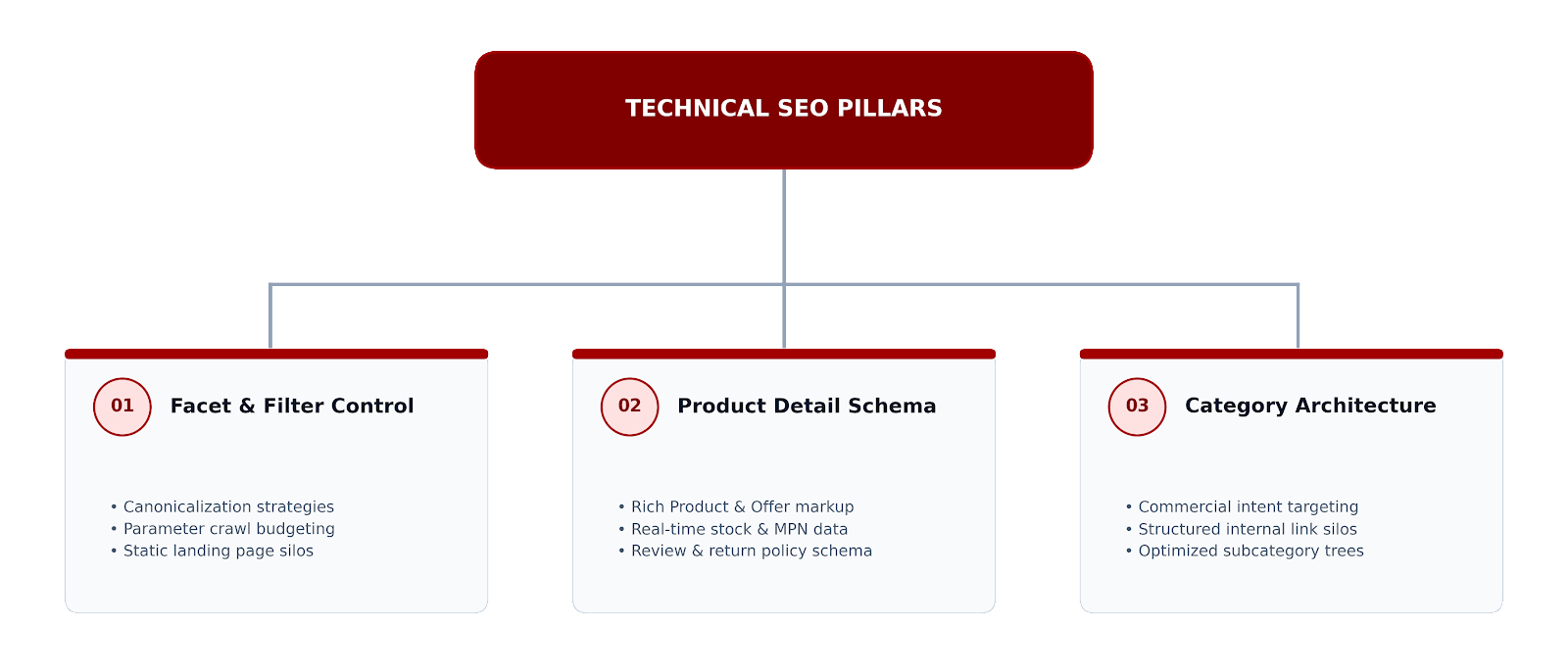
1. Managing Faceted Navigation and Crawl Budget
Large catalogs featuring calibers, barrel lengths, handguard configurations, and compatibility variations generate thousands of faceted parameter URLs. Unmanaged facets dilute crawl budget and cause severe duplicate content issues.
- Implement structured canonical tagging across all dynamic filter variants.
- Apply selective
noindex, followdirectives or use robots.txt disallows on low-value parameter combinations. - Create static, indexable landing pages for high-volume parameter combinations (e.g.,
/ar-15-barrels/16-inch-556).
2. Structured Data Markup and Product Availability
Ensure your store’s Data Layer dynamically renders schema markup across all product detail pages (PDPs).
- Utilize full
ProductandOfferschema, highlighting exact MPN (Manufacturer Part Number), SKU, brand, and real-time inventory availability. - Leverage
MerchantReturnPolicyandAggregateRatingstructured data to stand out on the SERP and improve organic click-through rates. For a step-by-step framework on schema deployment, see our breakdown on Product Page SEO Best Practices.
3. Strategic Category Page (PLP) Hierarchy
Category pages capture the highest-intent commercial queries across regulated verticals.
- Optimize Product Listing Pages (PLPs) with contextual content, structured internal linking modules, and clear H1/H2 hierarchy. Learn how to structure facets and internal link distribution in our guide to E-Commerce Category Page SEO.
- Build logical category silos separating unrestricted accessories (such as optics, cases, and range gear) from specialized parts to maximize relevance for broad commercial terms.
Key Takeaways for E-Commerce Leaders
Scaling a regulated retail enterprise requires an acquisition channel you control directly:
- Treat compliance as an operational priority: Avoid risky paid cloaking workarounds that endanger your domain’s longevity.
- Invest in search equity: Capture high-intent transactional queries directly through category-level and product-level optimization with an enterprise B2B & E-Commerce SEO Strategy.
- Partner with specialized talent: Work with a restricted products marketing agency and an experienced ecommerce advertising agency that understands the technical complexities of enterprise platforms like Adobe Commerce & Magento and Shopify Plus.
Scale Your 2A Brand Without Policy Vulnerability
Navigating ad restrictions and complex catalog SEO requires proven technical execution. At Crimson Agility, our comprehensive E-Commerce Growth & Development Services help high-risk, B2B, and 2A merchants engineer scalable architectures, optimize product data, and dominate organic search.
Ready to build a resilient acquisition engine? Contact our Regulated E-Commerce Specialists to audit your catalog and unlock predictable organic growth.