

Is AI going to replace SEO? If you run an ecommerce store, you’ve probably asked some version of the AI vs SEO question this year. Here’s the short version: AI isn’t competing with SEO the way Bing once competed with Google. It’s competing with the click, the traffic model most marketing budgets were built on.
Still, Google isn’t collapsing. Shoppers are far more comfortable letting AI research products than letting it buy them. And the fundamentals of SEO (crawlable pages, structured data, authority, content that answers real questions) matter more than ever, because AI builds its answers from them.
At Crimson Agility, we work inside the commerce platforms, product data and integrations that determine if AI systems can read your catalog, and we run SEO and digital marketing for online stores. Below, you’ll see what’s changing, what still works, and where to put your budget first. If you’d rather skip straight to your own results, our AI Readiness Assessment shows you how AI sees your store today.
The Short Answer on AI vs SEO
- Traditional SEO isn't dead, but "rank and wait for traffic" is. Rankings matter. They just don't guarantee the visit anymore.
- AI visibility is a data problem first. Assistants recommend products they can evaluate with confidence, and that confidence comes from complete, consistent, structured product information.
- Discovery is moving into AI. The purchase mostly isn't. Your buyers research in AI tools but tend to check out on your site, so your storefront has to convert the better-qualified visitors who land there.
What Is AI SEO?
AI SEO is the work of getting your brand found, understood and cited inside AI-generated answers: Google’s AI Overviews and AI Mode, ChatGPT, Gemini, Copilot and Perplexity. You’ll also hear it called generative engine optimization (GEO) or answer engine optimization (AEO). Different labels, same goal.
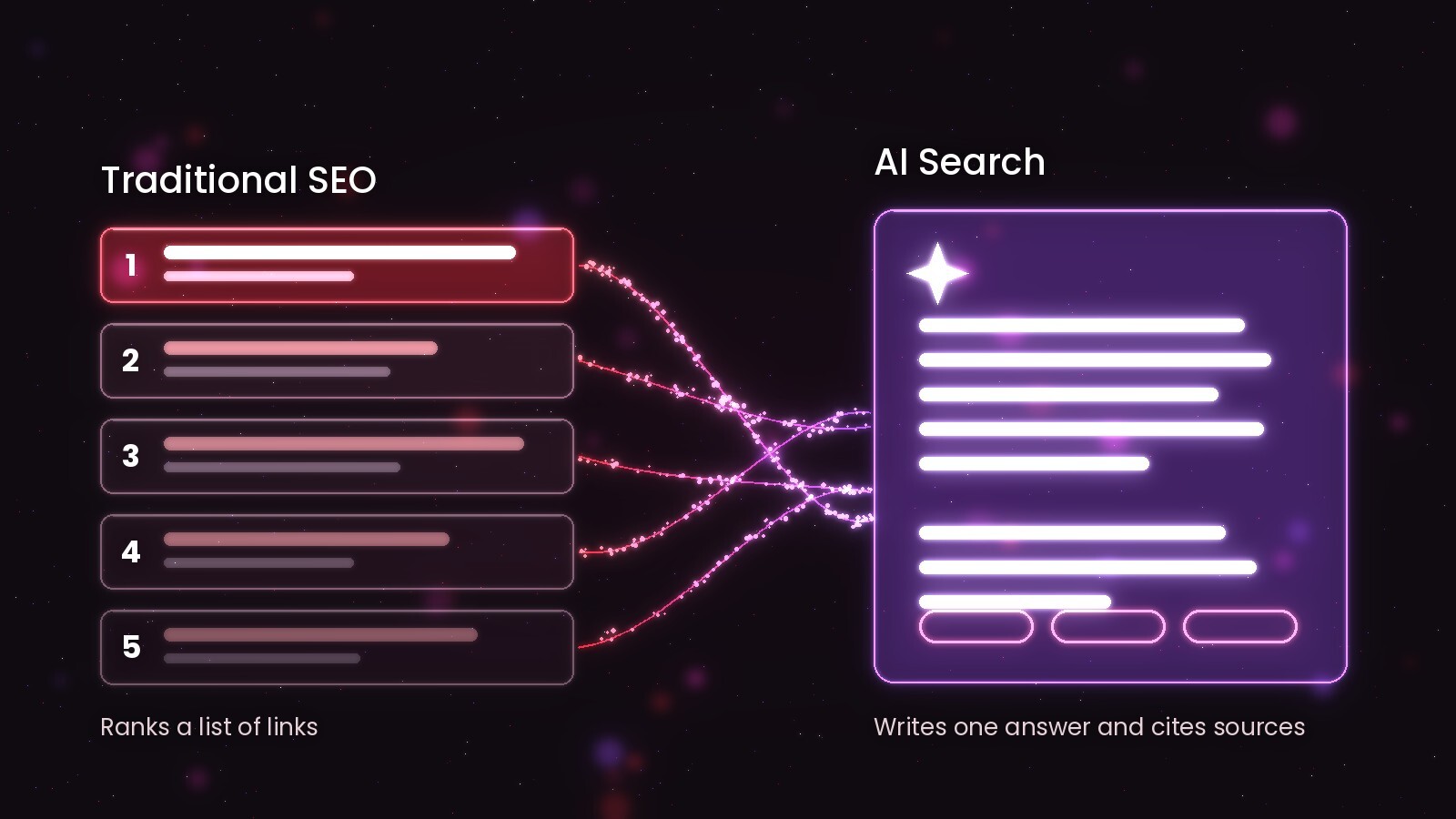
Traditional ecommerce SEO aims for a spot on a list of links. AI SEO aims for a spot inside the answer itself. The table below shows how the two compare.
| Traditional SEO | AI Search (AEO / GEO) | |
|---|---|---|
| Where it happens | Google and Bing results pages | AI Overviews, AI Mode, ChatGPT, Gemini, Copilot, Perplexity |
| What your buyer gets | A list of links | A written answer that names a few brands and cites sources |
| What wins | Relevance, technical health, authority, backlinks | Clear answers, original data, structured product information, consistent brand signals |
| Primary metric | Rankings and organic clicks | Citations, AI referral traffic, and the revenue it drives |
| What it depends on | A crawlable, fast, well-structured site | Everything SEO provides, plus clean product data from your platform, PIM and ERP |
These are differences in emphasis, not two separate systems. Google already uses AI all through search, and AI assistants lean on the same crawlable web that SEO built.
What the Data Shows About AI vs SEO
Studies use different methods and land on different numbers, but they all point one way: when an AI answer appears, fewer people click. Meanwhile, the people who do arrive from AI are unusually valuable.
| Finding | What the data shows | Source |
|---|---|---|
| Top-ranking pages lose clicks | Position-one click-through rate is about 58% lower on queries with an AI Overview (300,000 keywords, Dec 2023 to Dec 2025) | Ahrefs via Business Wire |
| People click less when AI summarizes | Users clicked a traditional result in 8% of visits with an AI summary, versus 15% without one | Pew Research, via eMarketer |
| The first controlled experiment | Hiding AI Overviews showed they cut outbound organic clicks by 38% where they appeared; zero-click searches rose from 54% to 72% | Search Engine Journal |
| Zero-click is now the norm | About 68% of U.S. Google searches ended without a click in early 2026 | SparkToro via TechWyse |
| AI shoppers buy more | AI-referred visits to U.S. retail sites convert 60% better and generate 53% more revenue per visit than other traffic (July 2026) | Adobe via Digital Commerce 360 |
| AI referrals are growing fast | ChatGPT referral traffic to websites grew 101% from January to August 2026 | BrightEdge via The Next Web |
| But Google is still far bigger | AI assistants sent about 1.25 sessions for every 100 from Google organic (Mar to Aug 2026, thousands of sites) | SEOCrawl |
| Buyers research with AI | 48% of online shoppers used AI to research their most recent purchase | Visa Acceptance Solutions and PYMNTS |
The realistic picture is segmentation, not replacement. Google and chatbots increasingly answer informational questions right on the page or in a chat window. Branded, local and high-intent shopping searches feel far less impact, so traditional SEO keeps paying off there, and Seer Interactive even saw click-through rates on AI Overview queries rebound in early 2026. For an online store, that’s good news: product and category searches are exactly the commercial queries that still send buyers.
Conversion numbers are the part most merchants miss. A year earlier, Adobe found AI visitors converted at roughly half the rate of everyone else. That has completely flipped. By the time a shopper clicks through from an AI answer, the AI has already done the comparison shopping, so they arrive ready to buy.
Why AI Isn't Killing SEO (It Runs on It)
Generative engines sit on top of the crawlable web. If search engines can’t crawl, index and make sense of your pages, AI systems have nothing of yours to work with. Google’s own guidance for its AI search features says the fundamentals it has long recommended apply here too: accessible pages, a good page experience, unique and useful content, and structured data that matches what’s visible on the page.
What’s changed is that ranking and getting cited are now two separate prizes. In mid-2025, about 76% of pages cited in AI Overviews also ranked in Google’s top 10. By early 2026, Ahrefs found that overlap had dropped to roughly 38%. AI systems break a buyer’s question into several smaller searches and pull from whichever pages answer each piece best. We walk through that process in How AI Search Works: From Keywords to Recommendations.
So what earns the citation? Princeton-led research that defined Generative Engine Optimization tested nine ways of rewriting content. Adding citations, statistics and quotations produced the biggest visibility gains in AI answers, while keyword stuffing didn’t help at all.
In other words, AI rewards what modern SEO already rewards: specific, evidence-backed content.
How to Show Up in AI Overviews: 4 Steps
Nobody can guarantee you a spot in AI Overviews. Each AI platform uses its own models, sources and selection rules, and answers shift from one query to the next. Be wary of any vendor selling guaranteed AI citations or a special file that supposedly makes AI recommend your brand. These four steps do move the needle.
1. Let the Crawlers In
Check robots.txt and any bot-blocking rules at your CDN or firewall, since those often shut out AI crawlers by accident. Make sure product details render in the HTML instead of hiding behind heavy JavaScript. Technical SEO is your entry ticket.
2. Answer the Question in the First Lines
AI Overviews pull short, direct passages. Open each section with a clear one- or two-sentence answer, then back it up with specs, numbers and sources. Comparison pages, buying guides and fitment guides with real data tend to earn more citations than generic category copy.
3. Match Your Structured Data to the Page
Product, Offer, Review and FAQ markup only helps when it matches what shoppers see. Validate it at the template level, so every product page and category page carries the same clean data.
4. Build Authority AI Can Verify
Put named experts on your content, grow your customer reviews, and keep your business details consistent across your site, distributors, marketplaces and directories. When your brand looks the same everywhere, AI systems trust it enough to cite it.
Buyers Let AI Research, but They Still Buy on Your Site
This is where AI vs SEO gets decided for online stores. Nearly half of online shoppers now use AI to research purchases. Handing over the actual transaction is a different story.
OpenAI sent the clearest signal. ChatGPT launched Instant Checkout in September 2025, then in March 2026 moved checkout back to merchants: shoppers find products in ChatGPT and finish the purchase on the merchant’s own checkout. Google is heading the other way with agentic checkout in AI Mode and Gemini, but it’s still in early access for select U.S. merchants. Microsoft also offers Copilot Checkout in the U.S.
For you, that’s not a threat. It’s a map:
- Discovery is moving into AI answers. Your product data and content decide whether AI considers you at all.
- Evaluation happens partly in AI and partly on your site. Your specs, reviews and comparisons decide whether shoppers choose you.
- Purchase still happens mostly on your storefront. Speed, a smooth checkout, and accurate stock and pricing close the sale.
Each stage is its own investment decision, and each one depends on the systems behind your storefront.
Why AI Needs Your Product Data, Not More Copy
Generic SEO advice stops working here, because ecommerce has a variable most content sites don’t: the catalog. Your visibility in AI answers depends on whether machines can confidently evaluate your products. Piling more AI-written text onto product pages won’t fix that.
Picture a fleet maintenance manager asking an AI assistant: “Which brake rotors fit a 2021 F-250 with the 6.2L engine, and who can ship 40 units by Friday?” To answer well, the AI needs:
- Year, make, model and engine fitment stored as structured attributes, not buried in a PDF or a paragraph of description text
- The same data on the product page, in the schema markup, and in every product feed
- Case-pack details, current pricing and live inventory pulled from the ERP
- Shipping and delivery information it can actually read
A merchant whose catalog answers that question in structured form is far easier for an AI to recommend than a competitor selling identical rotors with messy data. That’s a commerce systems problem, not a content marketing one, and it’s why we built our automotive commerce practice around fitment data. You’ll see the same pattern in industrial parts, firearms accessories, medical supplies and B2B distribution.
The fix usually lives deep in your commerce systems architecture, where your marketing team can’t reach alone:
| Where the gap usually is | What AI sees | What fixes it |
|---|---|---|
| PIM or product catalog | Missing or inconsistent attributes | Attribute model cleanup, enrichment, governance rules |
| ERP integration | Stale price and stock | Reliable sync to the platform and every feed |
| Platform templates | Thin or invalid schema | Template-level Product and Offer structured data |
| Product feeds | Data that contradicts the website | One source of truth feeding every channel |
| Rendering and performance | Content hidden behind heavy JavaScript | Server-rendered product content, Core Web Vitals fixes |
| B2B business rules | No way to show account pricing or quantity limits | Platform and integration work for customer-specific catalogs |
We dig deeper into this in Product Data vs. Product Pages: Why AI Search Changes Everything.
Curious how your catalog looks to a machine? Our readiness assessment grades your attributes, fitment, product relationships and compliance data, then ranks the gaps costing you the most AI visibility.
4 Phases of AI Readiness
Not every AI readiness project looks the same. Our AI Readiness Assessment scores your business across four phases, and each phase calls for different people and a different budget. Most brands should lock down the first two phases before spending heavily on the others, which is why our agentic commerce practice lives in your technology stack, not your media plan.
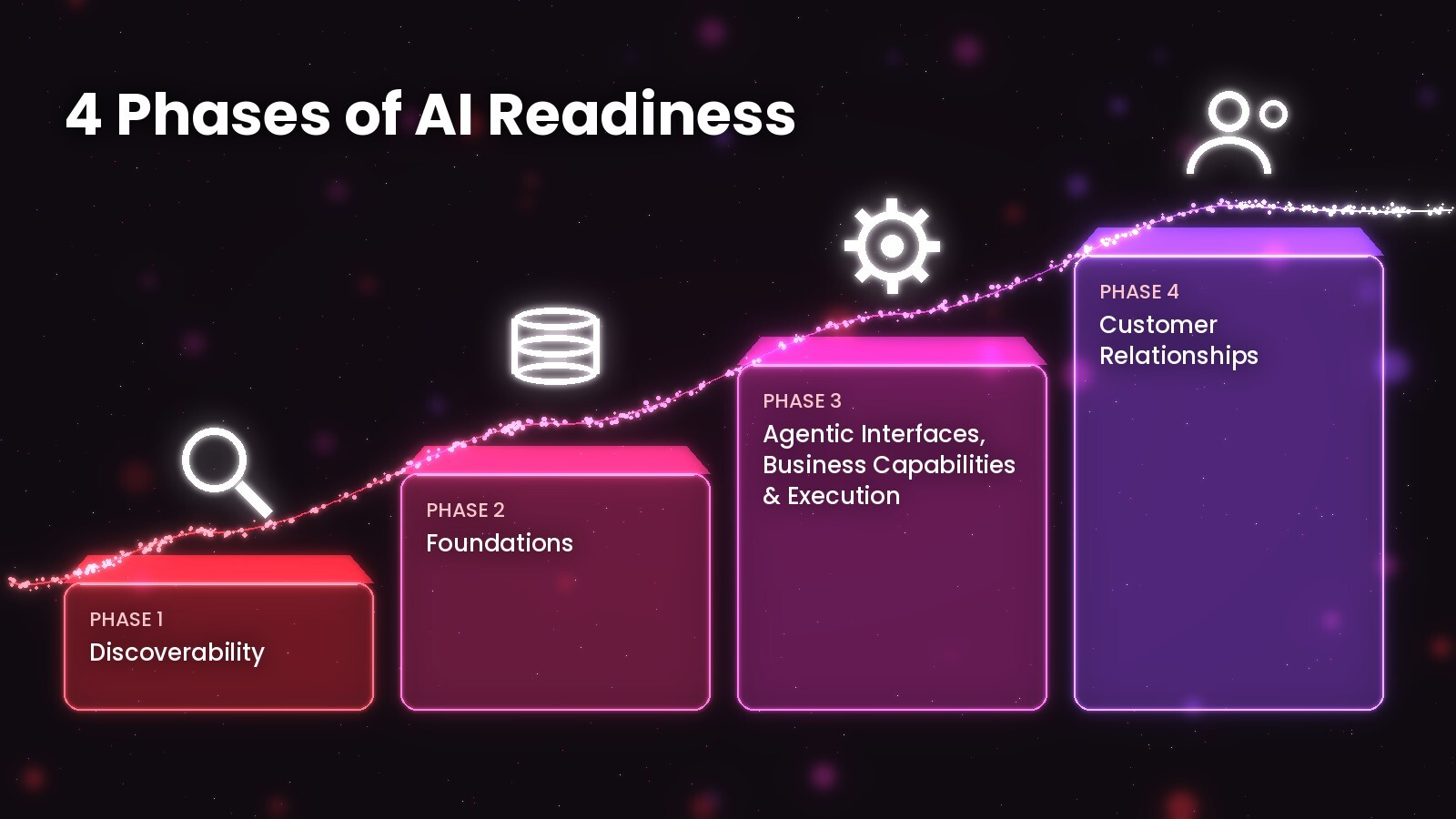
Phase 1: Discoverability
Can AI find you and cite you? This phase looks at crawlability, AI crawler access, structured data, and whether your brand shows up in AI Overviews, ChatGPT and Perplexity for the questions your buyers ask. Your SEO and content teams own most of this work.
Phase 2: Foundations
Being found isn’t enough if AI can’t understand what you sell. Foundations covers the product data underneath: attributes, fitment, product relationships and compliance details stored in typed fields instead of PDFs or free text, with one source of truth across your PIM, ERP and platform. Data and ecommerce teams usually lead here.
Phase 3: Agentic Interfaces, Business Capabilities & Execution
Once AI can read your catalog, the next question is whether an agent can act on it. Product feeds for Google Merchant Center and OpenAI’s Agentic Commerce Protocol, real-time price and stock from your ERP, B2B pricing rules, and checkout endpoints for standards like Google’s Universal Commerce Protocol all live here. Engineering and integration teams lead this phase, and as we’ve said before, agentic commerce is not about AI. It’s about trustworthy data.
Phase 4: Customer Relationships
An AI agent can make the first sale. Keeping that customer is on you. This phase connects accounts, order status, returns, loyalty and post-purchase service, so the relationship stays with your brand even when an agent sits in the middle.
Which phase is your store in? Our AI Readiness Assessment scores you across all four, then hands you a gap report with a prioritized list of what to fix first.
SEO Agency vs AI Optimization: Which One Do You Need?
In the AI vs SEO debate, you don’t have to pick one. AI optimization (or AI SEO) isn’t a separate discipline that replaces SEO. It’s SEO stretched across new surfaces, and it fails without the same technical foundation.
What you need is a partner who covers both, plus the systems underneath them. A traditional SEO agency that stops at keywords and backlinks will miss the product data, feeds and integrations that AI shopping depends on. An AI optimization vendor without technical SEO skills will build on sand. That’s the gap our ecommerce SEO services are built to close.
Ask any agency you’re vetting how they’d fix missing attributes in your PIM. Their answer tells you a lot.
How to Measure AI vs SEO Success When Clicks Shrink
Rankings and sessions alone won’t tell you the full story anymore. Track these five metrics side by side:
| Metric | Why it matters | Where to track it |
|---|---|---|
| AI referral sessions and revenue | AI visitors convert better, so small volumes count | GA4 or Adobe Analytics, with chatgpt.com, gemini.google.com, copilot.microsoft.com and perplexity.ai grouped as their own channel |
| AI search visibility | Shows whether you appear in AI Overviews and AI Mode | Search Console’s generative AI performance reports |
| Citation share | Shows whether you’re part of the answer on other AI platforms | A fixed list of 25 to 50 buyer questions, checked monthly in ChatGPT, Gemini and Perplexity |
| Product attribute completeness | The leading indicator for AI shopping visibility | PIM or catalog reports, by category |
| Conversion rate and revenue by source | Proves which channels drive the business | Analytics, segmented by traffic source |
The goal isn’t more traffic for its own sake. You want to be the brand AI recommends, then convert the smaller, better-qualified group of buyers who reach your site. Our assessment gives you a baseline for these metrics before you change anything.
Get Your AI Readiness Assessment
AI vs SEO is the wrong frame, because AI sits on top of the web that SEO built. If you’re not sure where your store stands, request an AI Readiness Assessment or reach out to our team with any questions about this post. We work across Adobe Commerce, Shopify, BigCommerce, Shopware and WooCommerce, and we’ll tell you what to fix first. Our entire team is based in the U.S., so you’ll talk to people who know your platform.