

Every discussion about agentic commerce begins with AI.
That’s the wrong place to start.
Commerce has never been about intelligence.
It has always been about trust.
A buyer trusts a product because the description is accurate. A buyer trusts a vendor because the specifications match what arrived. A buyer trusts a platform because the inventory data reflected reality. Commerce runs on trust — not capability.
Agentic commerce does not change that. It changes who needs to establish it.
In traditional commerce, a human buyer evaluated trust directly. They read the description. They looked at the reviews. They called a sales rep when something was unclear. They made a judgment.
In agentic commerce, an AI agent is making that evaluation on their behalf. And AI agents cannot judge. They can only verify.
The entire conversation about agentic commerce — which AI model, which agent framework, which platform has the best agentic capabilities — is a conversation about capability. It is not a conversation about trust.
And trust is the only thing that matters.
Agentic commerce is not an AI problem. It is a trust problem. And the AI cannot trust your data
What an AI agent is actually doing
Strip away the language. An AI shopping agent is a system that acts on behalf of a buyer. It receives a set of requirements and executes against them: find this product, within this budget, from approved vendors, meeting these specifications.
To execute, it works through five stages:
1
Identify candidate products
2
Evaluate whether those products meet the requirements
3
Compare options against each other
4
Make a selection
5
Complete the transaction
Every one of those stages is an act of verification. The agent is not being creative. It is not making judgment calls. It is checking information against criteria — and either the information supports a confident answer or it does not.
Here is what that looks like in practice.
FROM THE FIELD
A buyer asks an AI agent for hiking boots under $250 suitable for Patagonia. The agent isn’t valuable because it found boots. It’s valuable because it understood terrain requirements, weather resistance ratings, durability standards, current inventory levels, delivery timing to a specific location, return policy terms, and the buyer’s previous purchase preferences — and then cross-referenced all of that simultaneously. Every one of those inputs required structured, machine-readable information to produce a confident result. None of it required a smarter AI. It required better evidence.
This is the distinction that changes everything. The AI agent’s quality of output is entirely a function of the quality of evidence it receives.
AI can’t trust what it can’t understand. Structured data isn’t optimization. It’s evidence.
Three assumptions the industry is getting wrong
The conversation about agentic commerce is built on three assumptions. All three are incorrect in ways that lead organizations toward the wrong investments.
|
EXPECTATION
AI changes shopping. |
REALITY
AI changes discovery. Trust still determines whether a purchase is completed — and trust is a function of data quality, not AI capability. |
|
EXPECTATION
Structured data is for SEO. |
REALITY
Structured data is machine-readable evidence. It is the information an AI agent uses to evaluate whether your product is the correct answer to a buyer’s question. SEO is a secondary effect. |
|
EXPECTATION
AI replaces decisions. |
REALITY
AI accelerates confident decisions. It can only move fast when the evidence supports confidence. Incomplete or inconsistent data doesn’t slow the AI — it produces wrong answers at speed. |
The practical consequence of the third assumption is the most expensive. Gartner describes agentic AI as systems that “plan and take actions to complete longer-horizon tasks” — but notes that the quality of those actions is directly dependent on the quality of the information the agent has access to. Garbage in, confident garbage out.
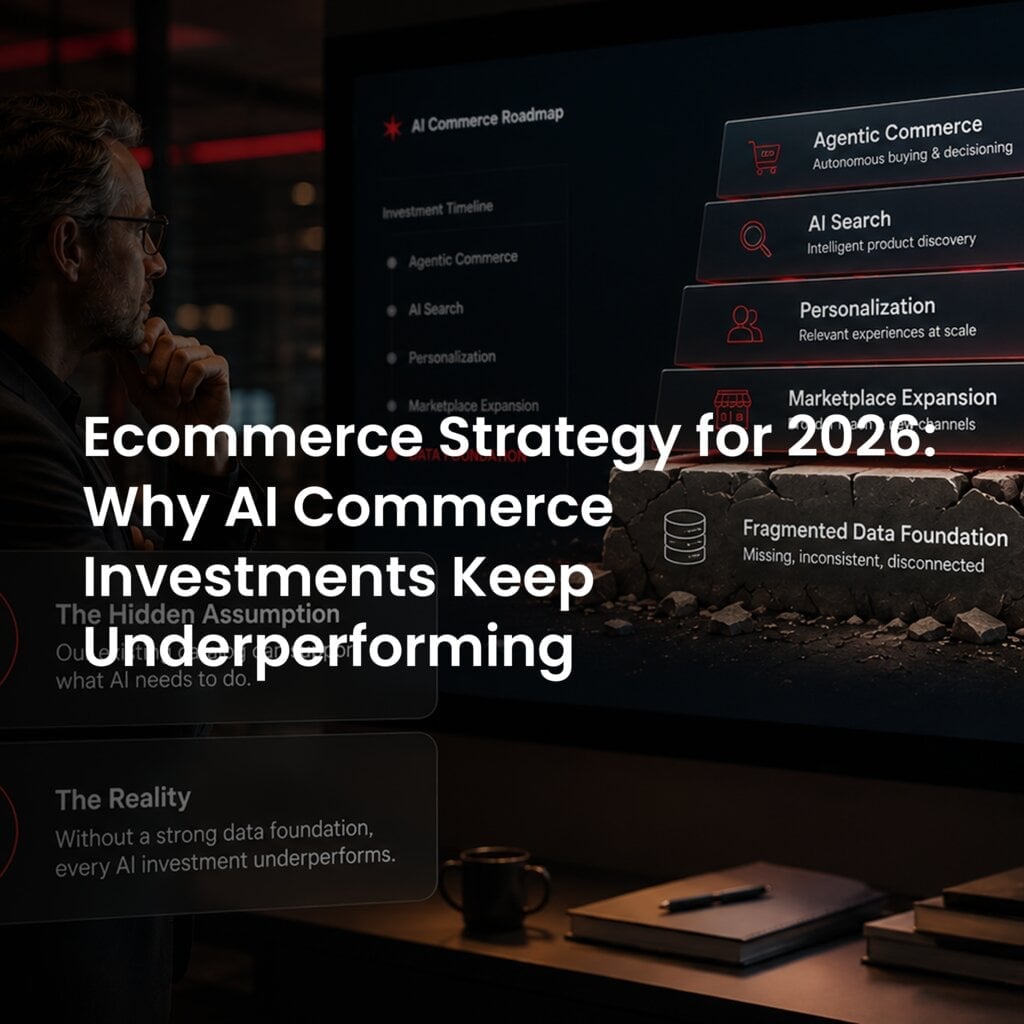
Businesses don’t have an AI problem. They have an evidence problem.
The AI agent doesn’t have the problem. Your catalog does.
When an AI agent fails to recommend your product — when it selects a competitor, returns an incorrect result, or cannot answer a buyer’s question — the instinct is to examine the AI.
Was the model good enough? Was the agent configured correctly?
Sometimes those are the right questions. Usually, they are not.
FROM THE FIELD
Most merchants optimize their customer experience before they optimize their data quality. The result is a commerce operation with excellent UX sitting on top of catalog data that an AI agent cannot reliably interpret. The agent evaluates the data layer, not the experience layer. A well-designed storefront does nothing for an AI that cannot parse the product information underneath it.
Usually the failure is in the catalog. The product data was incomplete. The attributes were missing. The compatibility information was in a PDF the agent could not parse. The taxonomy was inconsistent. The description was written for a human reader, not a machine parsing for evidence.
Akeneo’s 2024 research found that 98% of consumers have abandoned a purchase due to poor product information — a failure that compounds when AI systems are the interpreters, since they lack the human capacity to fill in gaps through inference or follow-up questions.
The AI agent is not the problem. The catalog is the problem.
Improving the AI does not fix a bad catalog. Adding more agentic features to your platform does not fix a bad catalog. A better agent framework does not fix a bad catalog.
Only fixing the catalog fixes the catalog.
FROM THE FIELD
Enterprises often maintain multiple conflicting versions of product truth. The ERP holds one set of specifications. The PIM holds another. The ecommerce platform holds a third — often a manually-maintained subset of the other two. An AI agent querying across these systems encounters contradiction. It cannot determine which system is correct. The result is not an error message. It is a wrong recommendation, stated with the same confidence as a correct one.
How commerce is actually changing
The shift from traditional to agentic commerce is not a technology change. It is a change in who the evaluator is — and what that evaluator needs to reach a confident decision.
TRADITIONAL COMMERCE —
Human evaluates evidence directly
Search → Buyer enters a query
Browse → Buyer scans results and follows interest
Compare → Buyer evaluates options using judgment and context
Trust → Buyer decides the information is sufficient to act
Purchase → Transaction completes
AGENTIC COMMERCE —
AI evaluates evidence on behalf of buyer
Intent → Buyer states requirements to an agent
Evidence → Agent queries structured data across sources — This is where most catalogs fail
Confidence → Agent determines whether evidence supports a recommendation
Decision → Agent selects or returns options — or fails to recommend if confidence is insufficient
Purchase → Transaction completes — or does not
The critical difference is in step two. In traditional commerce, a buyer fills in gaps through browsing and judgment. In agentic commerce, the agent cannot fill in gaps. It can only work with what exists in structured form. The evidence either exists or it does not.
Products with incomplete evidence are not ranked lower. They are absent from the confident recommendation set entirely.
AI readiness begins long before AI implementation. Businesses preparing for AI without fixing their data are preparing for the wrong future.
What trustworthy data actually requires
Agent-ready product data is not a format or a certification. It is a specific kind of evidence — the kind that allows a machine to reach a confident, correct decision without human assistance.
Trustworthy product data answers five questions explicitly, in structured form. Not in prose. Not in PDFs. In machine-readable attributes that can be queried, compared, and verified.
- What exactly is this product? A precise technical definition. Not a marketing description. Not a tagline. The specification that allows a machine to understand what the product is at a factual level.
- What is it for? The specific use cases, applications, and contexts where this product is the correct answer. Not “great for outdoor enthusiasts.” The terrain types, climate conditions, activity categories, and buyer profiles it was designed for.
- What does it fit, work with, or replace? Compatibility, fitment, cross-reference. The relational evidence that connects this product to the systems, environments, vehicles, or applications it belongs with. Structured as queryable attributes, not embedded in a description.
- What is it certified or approved for? Compliance, safety standards, regulatory approvals. The verification data that tells an agent this product meets the requirements a buyer’s purchase criteria may include. Not in a PDF attachment. In the data layer.
- Why would a buyer choose this over the alternative? The differentiating evidence. The specific attributes that make this product the correct answer for a specific buyer in a specific context.
Google’s structured data documentation confirms that complete, well-structured product markup directly improves eligibility for AI-generated product recommendations — and the same evidence requirements apply to every third-party AI system reading a catalog.
FROM THE FIELD
The provenance problem is underappreciated. An AI agent evaluating product information has no way to assess whether the data it is reading is current, accurate, or authoritative. It treats all available data as equally valid evidence. Organizations that have not established a single authoritative source for product information — and kept it current — are feeding agents a mixture of truth and outdated information, indistinguishably.
The window for acting first is open. It will not stay open.
The organizations that will lead in agentic commerce are not the ones adopting AI fastest. They are the ones building trustworthy data infrastructure before the AI adoption wave reaches their buyers.
Once agentic buying becomes the dominant discovery mechanism in a market — as it already is in parts of B2B procurement — the cost of data remediation increases significantly. The catalog problem that costs $200K to fix today costs $2M to fix when it is actively causing lost deals.
The sequence that wins
1
Audit what you actually have. What percentage of your product records have complete structured attributes? What evidence exists in PDFs, sales rep knowledge, or prose descriptions that has never been made machine-readable? You cannot build trustworthy data without first knowing how untrustworthy the current data is.
2
Identify where AI-mediated buying is arriving first. Which product categories are most exposed to agentic discovery? Where are your buyers already using AI procurement tools? Start building evidence quality in those categories first.
3
Define what evidence means for your products. The evidence a buyer’s AI agent needs to confidently recommend a pair of hiking boots is different from what it needs to recommend an industrial valve or a firearms accessory. Define the evidence standard for your specific products and buyers.
4
Build the evidence layer. Structure what is in prose. Extract what is in PDFs. Normalize what is inconsistent across systems. Establish a single authoritative source. Build the taxonomy that allows products to be compared and related.
5
Then evaluate the AI platforms. An AI agent operating against trustworthy, evidence-rich data is a competitive advantage. An AI agent operating against untrustworthy, incomplete data produces wrong answers at machine speed.
The sequence is not a preference. It is the difference between an AI investment that performs and one that doesn’t.
The companies that win won’t have the smartest AI
They’ll have the most trustworthy data.
Because in agentic commerce, AI won’t determine who wins.
Trust will.
The conversation the industry is having — about models, frameworks, platforms, and capabilities — is a conversation about the tool. The conversation that matters is about whether the evidence the tool is working with is accurate, complete, structured, and current.
Commerce has always been about trust. Agentic commerce does not change that.
It just makes the trust requirement machine-readable.