


The Google Ads Grant program represents one of the most valuable opportunities available to nonprofit organizations today.
With up to $10,000 per month available in free advertising on Google Search, this program can transform your organization’s digital presence and help you reach thousands of potential supporters.
Since its launch way back in 2003, this program has given more than $1.8 billion worth of advertising to nonprofits worldwide, driving over 14 billion clicks to nonprofit websites.
In this comprehensive guide, we will walk you through everything you need to know to secure and maximize your Google Ad Grant in 2025 – just like we’ve done for our clients.
We’ll cover everything from understanding the latest program updates to implementing advanced optimization strategies. You’ll discover how to leverage this powerful program to amplify your mission and, of course, achieve your organization’s financial goals.
Whether you are completely new to digital advertising or looking to optimize an existing Ad Grant account, this guide provides the insights and strategies you need to succeed.
4 Key Benefits of the Google Ad Grant for Your Nonprofit
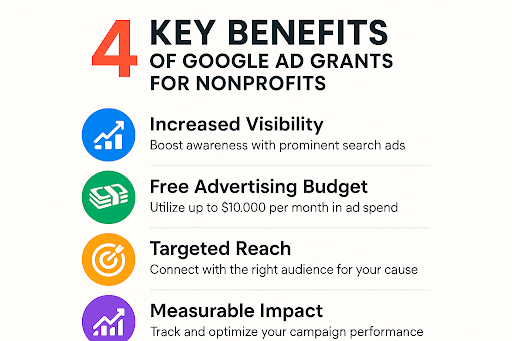
The benefits of utilizing Google’s Ad Grant program probably seem obvious, but we want to make sure you understand the main ones – especially if it’s your job to pitch it to your board.
The Google Ad Grant is far more than just free advertising.
It represents a strategic asset that can fundamentally transform your nonprofit’s digital outreach capabilities. By leveraging this grant effectively, you can unlock a comprehensive range of benefits that will help you achieve your organization’s most important goals.
1. Free Advertising Budget to Amplify Your Mission
Probably the most obvious benefit of the Google Ad Grant is the incredible budget you’re given for free.
With up to $10,000 per month in free advertising, your nonprofit gains access to the same powerful advertising platform used by Fortune 500 companies. This budget allows you to compete with larger organizations and ensures your cause receives the visibility it deserves, regardless of your marketing budget constraints.
The daily spending limit of $329 provides consistent exposure throughout the month, helping you maintain a steady stream of website visitors and potential supporters. This consistent visibility is crucial for building brand recognition and establishing your nonprofit as a trusted authority in your field.
Many nonprofits find that even spending a fraction of the available budget can dramatically increase their online presence and supporter engagement.
And think about it.
Consider the impact this budget can have on your organization’s reach.
Traditional advertising methods usually require massive upfront investments with uncertain returns.
The Google Ad Grant eliminates this financial barrier, so you can test different messaging strategies, target various audience segments, and refine your approach without worrying that your organization’s limited resources are in jeopardy.
2. Highly Targeted Reach to Connect with Passionate Supporters
Unlike traditional advertising methods that cast a wide net, Google Ads allows is fantastic for targeting your message with surgical precision.
You can reach users based on their
- Geographic Location
- Search Behavior
- Interests
…and even the specific, valuable keywords that people in your market are regularly searching for..
This targeting capability means you can connect with people who are already passionate about your cause or actively seeking the services you provide.
For example, if your nonprofit focuses on environmental conservation, you can target users searching for terms like:
- “climate change solutions”
- “environmental volunteering”
- “sustainable living tips”
This targeted approach ensures that your advertising budget is spent reaching the most relevant and engaged audiences, dramatically improving your return on investment compared to broad-based advertising approaches.
Advanced Targeting Capabilities
The precision of Google’s targeting extends beyond simple keyword matching. That’s really Google Ads at its most basic.
You can layer multiple targeting criteria to create highly specific audience segments. Geographic targeting allows you to focus on areas where your services are available or where you have the strongest community presence.
Furthermore, you can use audience insights to identify and target people who have previously visited websites related to your cause, searched for similar organizations, or demonstrated interest in related topics.
This level of targeting sophistication was previously available only to organizations with substantial advertising budgets, but the Google Ad Grant makes it accessible to nonprofits of all sizes.
3. Increased Online Visibility and Brand Recognition
By appearing at the top of Google search results, your nonprofit will significantly increase its online visibility and establish stronger brand recognition.
When potential supporters see your organization’s name consistently appearing in search results, it builds trust and credibility. This increased exposure can also help position your nonprofit as a leader in your field and makes it more likely that people will remember and support your mission.
The visibility provided by Google Ad Grants extends beyond just the immediate clicks, impressions, and conversions, though. Even when users do not click on your actual ads, they still see your organization’s name and message, contributing to overall brand awareness and recognition in your community. This phenomenon, known as “impression value,” can be particularly valuable for newer organizations or those working to establish themselves in competitive fields (or both).
Brand recognition becomes especially important during crisis situations or major fundraising campaigns. Organizations that have maintained consistent visibility through their Google Ad Grant often find that supporters are more likely to remember and respond to their appeals during critical moments. This sustained visibility creates a foundation of awareness that supports all of your marketing and fundraising efforts.
On top of that, appearing in search results alongside or near larger, well-known organizations can enhance your credibility by association. When users see your nonprofit’s ads appearing in the same search results as established organizations, it signals that your organization is legitimate and worthy of consideration.
4. Data-Driven Insights for Smarter Marketing Decisions
Google Ads provides an extensive array of data and analytics that can inform your broader marketing strategy.
You can track things like which:
- Keywords drive the most traffic
- Ad copy generates the highest click-through rates
- Landing pages convert the most visitors into supporters or donors
This wealth of data transforms your marketing from guesswork into a science-based approach.
And these insights extend far beyond your Google Ads campaigns.
The keyword data can inform your website content strategy, helping you understand what topics and phrases your audience cares about most.
The audience insights can guide your social media efforts, showing you which demographic groups are most engaged with your cause.
Conversions are great, but the data associated with them can help you optimize your entire digital marketing funnel, from initial awareness all the way through final conversion.
Geographic performance data reveals which areas show the strongest response to your messaging, helping you make informed decisions about where to focus offline outreach efforts or where to consider expanding your services. Time-of-day and day-of-week performance data can optimize your email marketing send times and social media posting schedules.
The platform also provides competitive insights, showing you which keywords your competitors are targeting and how your performance compares to industry benchmarks. This competitive intelligence can help you identify new opportunities and avoid oversaturated markets where your budget might be less effective.
5 Steps to Secure and Maximize Your Google Ad Grant
Alright, now that you’re (hopefully) sold on the benefits of this program for your nonprofit, let’s talk about how to start leveraging them ASAP.
Of course, you can always just contact us and we can do it for you, but we’re also happy to explain the process involved step-by-step.
Just follow these five comprehensive steps to navigate the process efficiently and set yourself up for long-term success.
Step 1: Confirm Your Organization’s Eligibility
Before beginning the process, you must ensure that your organization meets all eligibility requirements for the Google for Nonprofits program. Your organization must be a registered charitable organization in good standing in your country and meet the full eligibility requirements specific to your location.
Basic Eligibility Requirements by Country
The eligibility requirements vary significantly by country, reflecting different legal frameworks and charitable organization structures around the world.
In the United States, organizations must hold valid 501(c)(3) status and be registered with the IRS.
In the United Kingdom, organizations must be registered with the Charity Commission for England and Wales, the Office of the Scottish Charity Regulator, or the Charity Commission for Northern Ireland.
Organization Types That Are Excluded
Now, certain types of organizations are not eligible for the program regardless of their charitable status.
If your organization is one of the following, unfortunately, you don’t qualify for the program:
- Governmental entities
- Hospitals
- Healthcare Organizations
- Schools or Academic Institutions
These exclusions are because of Google’s desire to focus the Ad Grant program on organizations that might not otherwise have access to substantial advertising budgets.
So, for example, hospitals and schools often have other funding sources for marketing and outreach, while governmental entities have different accountability requirements that make the program structure less suitable.
Additional Country-Specific Requirements
Some countries have additional requirements or restrictions that you need to consider before applying.
For example, a lot of countries require organizations to demonstrate a minimum level of annual revenue or to have been operating for a specific period before becoming eligible.
Before proceeding with your application, thoroughly review the eligibility requirements for your specific country and organization type. If you are unsure about your eligibility, consider contacting Google for Nonprofits support or, again, just contact us.
Step 2: Prepare Your Website for Success
Your website serves as the foundation for your Google Ad Grant success, and Google maintains strict quality standards for participating organizations. These standards ensure that users who click on Ad Grant ads have a positive experience and find valuable, relevant information about your organization and its work.
Content and Mission Requirements
Your website must provide a clear and detailed description of your mission and activities.
This goes beyond a simple mission statement.
Google literally expects to see comprehensive information about your programs, services, impact, and the communities you serve. Your mission statement must be clear, concise, and prominently displayed on your main page where visitors can easily find it.
The content should be substantial enough to give visitors a complete understanding of your organization’s work and how they can get involved or support your efforts. Your website must also demonstrate that commercial activity is not the primary goal of your organization.
While limited commercial activities are permitted, you must clearly explain how these activities support your mission.
Technical and Performance Standards
Technical requirements include having a valid HTTPS security certificate, which encrypts data transmitted between your website and visitors’ browsers. This security measure is essential for protecting user privacy and building trust, especially if your website includes donation forms or other areas where users might enter personal information.
Website performance is another critical factor.
Your targeted pages must meet Google’s minimum standards for ads-based destination URLs. Low-performing pages not only frustrate users but also negatively impact your Quality Score in Google Ads, which can reduce your ad visibility and effectiveness.
Legal and Policy Requirements
Your website must also include proper privacy and information sharing policies that can be accessed by users from any page. These policies should clearly explain how you collect, use, and protect visitor information, and they must be easily accessible through footer links or other prominent navigation elements.
Additionally, your website must display your proper 501(c)(3) status, including your organization’s legal name, contact information, and physical address. This transparency helps build trust with potential supporters and meets Google’s verification requirements.
User Experience and Content Freshness
Navigation and user experience are equally important.
Visitors should be able to easily find information about your programs, ways to get involved, and how to contact your organization. Include clear calls-to-action that guide visitors toward meaningful engagement, whether that is making a donation, signing up for your newsletter, or volunteering for your programs.
Content freshness is another factor Google considers when evaluating website quality. Regularly update your website with news about your programs, upcoming events, success stories, and other relevant information.
Step 3: Navigate the Google for Nonprofits Application Process
Once you have confirmed your eligibility and prepared your website, you can begin the Google for Nonprofits application process. This multistep process involves verification of your organization’s charitable status and review of your website to ensure it meets program standards.
Creating Your Google for Nonprofits Account
The first step is creating a Google for Nonprofits account using an email address associated with your organization’s domain. Avoid using personal email addresses like Gmail or Yahoo, as Google prefers to see organizational email addresses that demonstrate your connection to the nonprofit.
During the application process, you will need to provide detailed information about your organization, including your legal name, address, mission statement, and areas of focus. Be thorough and accurate in completing these fields, as inconsistencies or incomplete information can delay the verification process.
The Verification Process
The verification process is handled by one of Google’s trusted verification partners, such as Percent or TechSoup, depending on your country. These organizations specialize in verifying the charitable status of nonprofits and have access to official databases and registries.
Verification typically takes between 2-14 business days, though it can take longer during peak application periods or if additional documentation is required. During this time, the verification partner may contact you to request additional information or clarification about your organization’s status or activities.
Activating Your Ad Grant
Once your organization is verified, you will receive an email notification and can proceed to activate the Google Ad Grants product within your Google for Nonprofits account. This activation process includes agreeing to the Ad Grants program policies and terms of service, which outline your responsibilities as a program participant.
After activation, you will receive an invitation to create your Google Ads account specifically for the Ad Grant program. This account will have special settings and limitations that differ from regular Google Ads accounts.
Step 4: Master the Art of Ad Grant Management
Effective Ad Grant management requires ongoing effort and attention to detail, as well as a deep understanding of the unique requirements and limitations that apply to Ad Grant accounts.
Success in this area separates organizations that achieve significant impact from their grants from those that struggle to maintain compliance or generate meaningful results.
Even though you’re getting money for free, that’s no excuse to not learn the ropes when it comes to Google Ads. You should be constantly revising and even testing your campaigns for best results.
Maintaining Click-Through Rate Requirements
And here’s another BIG reason to pay close attention to how your nonprofit’s ads are performing.
The most critical compliance requirement is maintaining a minimum 5% click-through rate across your entire account. This requirement ensures that your ads remain relevant and engaging to users, and it reflects Google’s commitment to providing high-quality search results.
Achieving and maintaining a 5% click-through rate requires careful attention to keyword selection, ad copy quality, and landing page relevance. Focus on keywords that closely align with your organization’s mission and services, and avoid broad or generic terms that might attract clicks from users who are not genuinely interested in your cause.
Keyword Selection and Quality Requirements
Keyword selection is particularly important for Ad Grant accounts due to several unique restrictions.
First of all, you can’t use single-word keywords except for branded terms related to your organization’s name. This restriction encourages more specific, targeted keyword selection that is likely to attract more qualified traffic.
Secondly, all keywords must maintain a Quality Score of at least 3 out of 10. Quality Score is Google’s assessment of how relevant your keywords are to your ad copy and landing pages, as well as how likely users are to click on your ads.
A 3 shouldn’t be hard to hit but – one more time – this is why you need to constantly check how your ads are performing and work to maintain (or even improve) its quality scores.
Bidding Restrictions and Smart Bidding Options
Bidding restrictions are another important consideration for Ad Grant accounts.
All keyword bids are capped at $2 per click unless you utilize Smart Bidding strategies. The approved Smart Bidding options for Ad Grant accounts include Maximize Conversions, Maximize Conversion Value, and Target Return on Ad Spend (tROAS).
Importantly, Maximize Clicks no longer qualifies as Smart Bidding for the purposes of this cost-per-click limitation, so accounts using this strategy will be subject to the $2 maximum bid restriction.
Account Maintenance and Conversion Tracking
Regular account maintenance is essential for both compliance and performance. You must log into your account at least twice per month and make meaningful changes at least every 30 days.
These changes might include updating ad copy, adjusting keyword bids, adding negative keywords to prevent irrelevant clicks, or optimizing landing pages based on performance data.
I also strongly recommend conversion tracking, which may become a requirement for maintaining your account. Set up tracking for meaningful actions that align with your organization’s specific goals, such as newsletter sign-ups, volunteer registrations, event attendance, or donation completions.
Importantly, your conversions must not equal the number of clicks over any 30-day period. Basically, you can’t report a 100% conversion rate. That’s pretty much impossible and would therefore strongly suggest improper tracking setup or artificial conversion inflation.
Step 5: Leverage the Latest 2025 Program Updates
Google introduced several significant updates to the Ad Grants program in 2025 that provide new opportunities for nonprofits to expand their reach and effectiveness.
Staying informed about these updates and implementing them strategically can give your organization a significant advantage over competitors who have not yet adapted to the new features.
Global Program Expansion
The most notable update is the expansion of the program to over 100 new countries and territories, making the program accessible to nonprofits in many more locations worldwide.
This expansion reflects Google’s commitment to supporting nonprofit organizations globally and recognizes the important role that local nonprofits play in their communities.
For organizations in newly eligible countries, this expansion represents an unprecedented opportunity to access sophisticated digital marketing tools that were previously unavailable. The program expansion includes not only Ad Grants but also access to other Google for Nonprofits products, such as Workspace for Nonprofits and YouTube Nonprofit Program features.
Campaign Type Updates and Limitations
Ad Grant accounts are primarily limited to Search campaigns that target only the Google Search network. Search partners and the display network are not available for Ad Grant accounts, ensuring that your ads appear exclusively in Google search results where users are actively looking for information related to your cause.
However, the introduction of Performance Max campaigns represents a major advancement for select Ad Grant users in 2025. These AI-powered campaigns can automatically optimize your ads across multiple Google platforms, including Search and the newly added Google Maps placements.
Google Maps Integration and AI Enhancements
The integration with Google Maps is particularly exciting for nonprofits that serve local communities or operate physical locations. Google Maps ads can appear as location pins directly on the map interface or as sponsored results within Google Maps search results.
Additionally, Google has enhanced the AI capabilities available to nonprofits through Workspace for Nonprofits, including advanced features like NotebookLM Audio Overviews and Gemini Deep Research. These tools can help you create more effective content, better understand your audience, and develop more sophisticated marketing strategies that complement your Ad Grant campaigns.
3 Common Google Ad Grant Myths Debunked
Despite the program’s long history and proven success, there are still several persistent myths that continue to discourage many nonprofits from taking advantage of this valuable resource.
These misconceptions often stem from outdated information, misunderstandings about program requirements, or confusion with regular Google Ads accounts.
So, let’s examine and debunk three of the most common and damaging myths about the Google Ad Grant program.
Myth #1: You Must Spend the Full $10,000 Each Month or Lose Access
This misconception causes unnecessary stress for many nonprofit organizations and can lead to poor spending decisions that waste the grant on irrelevant keywords or ineffective campaigns. The reality is that you are not penalized for failing to spend the full $10,000 monthly allocation, and Google will never close your account simply because you did not reach the maximum spending limit.
In fact, very few organizations consistently spend the entire amount available to them, and this is perfectly acceptable within the program guidelines. The daily spending limit of $329 is designed to pace your spending throughout the month, but if your campaigns do not generate enough relevant clicks to reach this limit, your account will remain in good standing.
Focus on Quality Over Quantity
The objective of the program is not to spend as much money as possible, but to use the grant effectively to share your mission and connect with potential supporters.
It is far better to have a well-managed account that spends a smaller portion of the grant efficiently than to waste money on irrelevant keywords or poorly targeted campaigns just to reach the spending limit.
Instead, focus on:
- Building campaigns that target relevant keywords
- Creating compelling ad copy
- Driving qualified traffic to optimized landing pages
As your campaigns improve and you identify more opportunities to reach your target audience, your spending will naturally increase (as well as your results).
Myth #2: Ad Grant Ads Cannot Compete with Paid Advertisers
While it is true that Ad Grant ads appear below paid ads in search results, this positioning does not prevent you from achieving significant success with your campaigns. Google Ad Grants and paid Google Ads operate in separate auctions, so you are not directly competing with paid advertisers for the same positions.
The separation of Ad Grant and paid ad auctions means that your ads will appear in designated positions below paid ads, but above organic search results. This positioning still provides excellent visibility, especially for users who are specifically searching for nonprofit organizations or charitable causes.
Strategic Keyword Targeting for Better Positioning
As I touched on above, by focusing on relevant, long-tail keywords and creating high-quality ad copy, you can achieve excellent click-through rates and drive substantial traffic to your website. The key is to target keywords that align closely with your mission and services, rather than trying to compete for highly generic terms that may not be relevant to your audience anyway.
Long-tail keywords often have less competition from paid advertisers, giving your Ad Grant ads even better positioning and visibility.
For example, instead of targeting the broad term “charity,” you might target more specific phrases like “environmental conservation volunteer opportunities” or “local food bank donation guidelines.”
Myth #3: The Grant Can Only Be Used for Direct Fundraising
This narrow view of the program’s potential significantly limits its effectiveness for many organizations and prevents them from realizing the full value of their Ad Grant.
While the grant can certainly be a powerful tool for fundraising, it can also support a wide variety of other organizational goals that are equally important for nonprofit success.
Multiple Ways to Use Your Ad Grant
You can use the grant to raise awareness about your cause, which is often a necessary precursor to fundraising success. Many potential supporters need to learn about an issue or organization before they are ready to make a financial contribution.
Volunteer recruitment is another excellent use of Ad Grant campaigns. Many nonprofits rely heavily on volunteers to deliver their programs and services, and finding qualified volunteers can be just as valuable as raising funds.
Event promotion is another valuable use of your Ad Grant budget.
Whether you are hosting fundraising events, educational workshops, community meetings, or awareness campaigns, Google Ads can help you reach people who are interested in attending.
Building Long-Term Supporter Relationships
Educational content promotion can help establish your organization as a thought leader in your field while providing valuable information to your community. You can use your Ad Grant to drive traffic to:
- Blog posts
- Research reports
- Resource guides,
…or other educational materials that demonstrate your expertise and provide value to your audience.
Newsletter sign-ups and other forms of engagement can also be just as valuable as immediate donations. Building an email list of engaged supporters provides you with a direct communication channel that you can use for ongoing relationship building, education, and fundraising appeals.
2 Powerful New Features in 2025: Performance Max and Google Maps
The biggest updates to the Google Ad Grants program in 2025 were the introduction of Performance Max campaigns and the integration with Google Maps advertising.
These new features provide nonprofits with powerful new ways to reach their target audiences and expand their digital marketing effectiveness beyond traditional search advertising.
Unlocking New Audiences with Performance Max Campaigns
Performance Max represents a fundamental shift in how Google Ad Grant campaigns can operate, moving beyond the limitations of just keyword targeting to leverage artificial intelligence and machine learning for audience discovery and campaign optimization.
These AI-powered campaigns use Google’s advanced algorithms to automatically optimize your ads across multiple platforms within the Google ecosystem.
How Performance Max Differs from Traditional Campaigns
Unlike traditional search campaigns that rely on specific keyword lists, Performance Max campaigns use audience signals, conversion data, and creative assets to identify and reach potential supporters wherever they are most likely to engage.
The system analyzes your website content, conversion history, and audience interactions to build a comprehensive understanding of who your ideal supporters are and where they can be found online.
For Ad Grant accounts, Performance Max campaigns currently support Search and Google Maps placements, with the potential for expansion to additional platforms in the future. This limitation ensures that Ad Grant users can benefit from the advanced optimization capabilities while maintaining the program’s focus on search-based advertising.
Setting Up Performance Max Campaigns
The setup process for Performance Max campaigns also differs significantly from traditional search campaigns.
Instead of selecting specific keywords, you provide the system with high-quality creative assets, clear conversion goals, and audience signals that help guide the optimization process.
Creative Assets and Conversion Goals
Creative assets for Performance Max campaigns include headlines, descriptions, images, and logos that the system can mix and match to create the most effective ad combinations for different audiences and placements. Providing a diverse range of high-quality assets gives the system more flexibility to optimize your campaigns for different contexts and user preferences.
Conversion goals are crucial for Performance Max success, as the system optimizes specifically to achieve the actions that are most valuable to your organization.
Whether your primary goal is newsletter sign-ups, volunteer registrations, or donation completions, clearly defining these objectives helps the system focus its optimization efforts on the outcomes that matter most to your mission.
Monitoring and Optimization
The AI-powered optimization process continuously learns from campaign performance and adjusts targeting, bidding, and creative combinations to improve results over time. This means that Performance Max campaigns often start with modest performance and improve significantly as the system gathers more data and refines its approach.
Monitoring Performance Max campaigns requires a different approach than traditional campaigns, as you have less direct control over specific targeting and bidding decisions. Instead, focus on providing high-quality conversion data, regularly updating your creative assets, and analyzing performance at the campaign level rather than the keyword level.
Reaching Local Supporters with Google Maps Integration
The integration of Google Ad Grants with Google Maps represents a particularly exciting opportunity for nonprofits that serve local communities, operate physical locations, or need to drive foot traffic to events and facilities. This feature addresses a long-standing limitation of the Ad Grants program, which previously focused exclusively on search advertising.
2 Types of Google Maps Ad Formats
Google Maps ads can appear in two different formats, each serving different user needs and search contexts. Location pins appear directly on the map interface when users are browsing or searching for businesses and organizations in a specific area.
Sponsored results appear within Google Maps search results when users search for specific types of organizations or services.
For example, if someone searches for “food banks near me” or “volunteer opportunities,” your sponsored result can appear alongside organic results, providing additional visibility for your organization.
Benefits for Local Organizations
This feature is especially valuable for organizations that need to drive foot traffic to physical locations. Food banks can use Maps ads to help people find their pantry locations and learn about distribution hours. Community centers can promote upcoming events to people searching for local activities.
The local targeting capabilities of Google Maps ads are especially sophisticated, allowing you to reach people based on their current location, frequently visited places, or areas where they have shown interest. This precision targeting ensures that your ads are shown to people who are most likely to be able to visit your location or attend your events.
Setting Up Google Business Profile Integration
To take advantage of Google Maps advertising, you must first connect your Ad Grant account to a verified Google Business Profile. This profile serves as the foundation for your Maps presence and should include complete, accurate information about your organization, including your address, phone number, website, hours of operation, and photos of your location.
Creating location assets within your Google Ads account allows you to use your physical address and location information in your campaigns. These assets can be used across different campaign types and help ensure that your location information is consistent and accurate across all your advertising efforts.
The combination of Performance Max campaigns and Google Maps integration creates new opportunities for sophisticated local marketing strategies. You can use Performance Max campaigns to reach broad audiences across multiple platforms while using Maps-specific campaigns to target users who are actively looking for local services or organizations.
6 Advanced Strategies to Maximize Your Ad Grant Performance
Beyond the basic setup and management requirements, there are also several advanced strategies that can significantly improve your Ad Grant performance and help you achieve better results from your campaigns.
These strategies require more sophisticated planning and execution, so I wouldn’t recommend you start them right away when you’re new to the Ads Grant Program.
However, these strategies are fantastic for dramatically increasing the impact of these campaigns once you’ve gained some experience with them.
Strategy 1: Implement Comprehensive Conversion Tracking
Effective conversion tracking is the foundation of successful Ad Grant management, as it allows you to measure the true impact of your campaigns and optimize for meaningful results rather than just clicks and impressions.
Many nonprofits make the mistake of focusing solely on website traffic, but tracking actual conversions provides much more valuable insights for campaign optimization.
If you want help with accurate tracking or building custom reporting around your most important metrics – whether it’s for Google Ads, SEO, email or anything else – feel free to contact us.
Setting Up Multiple Conversion Actions
First, set up multiple conversion actions that align with your organizational goals and the different ways people can engage with your mission.
Primary conversions might include donation completions, volunteer registrations, or event sign-ups. Secondary conversions could include newsletter subscriptions, resource downloads, or contact form submissions.
Use Google Tag Manager to implement tracking codes consistently across your website, ensuring that all conversion actions are properly measured regardless of which pages users visit or which paths they take through your site. Tag Manager also makes it a lot easier to update and maintain your tracking codes as your website evolves or as you add new conversion goals.
Advanced Tracking Techniques
Assign appropriate values to different conversion actions based on their importance to your organization.
For example, a donation completion might have a higher value than a newsletter sign-up, reflecting the immediate impact on your organization’s resources.
Implement enhanced conversion tracking where possible, which provides more accurate measurement by using hashed customer data to track conversions that might otherwise be missed due to privacy restrictions or technical limitations. This enhanced tracking is particularly important as privacy regulations and browser changes make traditional tracking methods less reliable.
Long-Term Impact Measurement
Set up conversion windows that reflect your organization’s typical supporter journey. Some people may donate immediately after clicking an ad, while others might take weeks or months to make their first contribution.
Monitor both immediate conversions and longer-term engagement metrics to understand the full impact of your campaigns. Users who initially sign up for your newsletter might become major donors months later, and tracking these longer-term outcomes helps you understand the true value of your advertising efforts.
Strategy 2: Develop Location-Specific Campaign Strategies
If your nonprofit serves multiple geographic areas or operates in different locations, create separate campaigns for each region with tailored messaging and keywords. This will significantly improve your campaign performance and relevance to local audiences.
Researching Local Market Differences
Research the specific needs, interests, and search behaviors of each geographic area you serve. Urban and rural communities often have different priorities and challenges, and your advertising messages should reflect these differences.
Create location-specific keyword lists that include local landmarks, neighborhood names, and region-specific terminology. People often search using local references that might not be obvious to someone unfamiliar with the area.
Creating Localized Ad Copy and Campaigns
Develop ad copy that speaks directly to local audiences and references specific community needs or challenges. Mentioning local partnerships, community events, or region-specific programs can make your ads more relevant and compelling to local users.
Consider creating campaigns that target different geographic areas with varying levels of specificity. You might have broad campaigns targeting your entire service area and more focused campaigns targeting specific cities or neighborhoods where you have a strong presence or particular expertise.
Use location-specific landing pages that provide relevant information for each geographic area you serve. These pages should include local contact information, area-specific programs or services, and information about local partnerships or community involvement. This localized approach improves user experience and can boost your Quality Scores.
Leverage the new Google Maps integration to create location-specific campaigns that drive foot traffic to your various locations. Each location can have its own campaign with tailored messaging about the specific services or programs available at that site.
Strategy 3: Leverage Audience Insights for Better Targeting
The audience insights available in Google Ads provide valuable information about who is engaging with your campaigns and website, and this data can help you refine your targeting, create more relevant ad copy, and identify new opportunities for audience expansion.
Analyzing Demographic and Interest Data
Again, I can’t stress this enough: even if it’s free money, it is vital that you constantly review your ads for opportunities to improve their performance.
Regularly review demographic data to understand things about your market like their age, gender, and household income characteristics of your most engaged audiences. This information can help you tailor your messaging to resonate with these groups and identify potential gaps in your current outreach efforts.
Analyze interest categories and affinity audiences to understand what other topics and causes your supporters care about. This will help you identify partnership opportunities, develop content that appeals to your audience’s broader interests, and find new keywords or topics to target in your campaigns.
Optimizing Based on Performance Patterns
Use geographic performance data to identify areas where your campaigns are performing particularly well or, alternatively, where they’re struggling. This information can help you adjust your geographic targeting, allocate budget more effectively, or identify areas where you might need to develop stronger local partnerships or presence.
Device and time-of-day performance data can help you optimize your bidding strategies and ad scheduling. If your campaigns perform better on mobile devices during evening hours, you can adjust your bids to be more competitive during these high-performance periods.
Strategy 4: Create Seasonal Campaign Calendars
Develop a strategic calendar that aligns your Ad Grant campaigns with seasonal trends, awareness months, and key events in your sector. This will take your ROI to the next level during periods of peak interest and engagement.
Planning for Seasonal Opportunities
Research the seasonal patterns that affect your cause area and plan your campaigns accordingly.
Many nonprofits see significant variations in search volume and engagement throughout the year, and anticipating these trends allows you to prepare more effective campaigns and allocate your budget strategically.
For example, if you run an environmental organization, you might increase your advertising during Earth Month in April. If you have an educational nonprofit, you’d probably focus on back-to-school periods in late summer. Healthcare nonprofits might align their campaigns with relevant awareness months, such as Breast Cancer Awareness Month in October or Mental Health Awareness Month in May.
You get the idea.
Balancing Seasonal and Evergreen Campaigns
Plan your campaign calendar well in advance, allowing time to develop seasonal ad copy, create relevant landing pages, and adjust your keyword strategies.
Seasonal campaigns often require different messaging and targeting approaches than your year-round campaigns, and this preparation time is crucial for success.
Develop evergreen campaigns that can run year-round alongside your seasonal efforts. These campaigns provide consistent visibility and traffic while your seasonal campaigns capitalize on peak interest periods.
Monitor your seasonal campaign performance carefully and document what works well for future years. Seasonal trends can shift over time, and maintaining detailed records helps you refine your approach and improve your results year over year.
Strategy 5: Optimize for Mobile User Experience
With the majority of Google searches now occurring on mobile devices, ensuring that your campaigns and landing pages are optimized for mobile users is crucial for Ad Grant success.
Mobile users often have different intent and behavior patterns than desktop users, and tailoring your approach accordingly can significantly improve your campaign performance.
Mobile Site Speed and User Experience
Review your mobile site speed regularly using tools like Google PageSpeed Insights or GTmetrix (I use both), as mobile users are particularly sensitive to slow-loading pages. Even small improvements in loading speed can result in better user experience, higher Quality Scores, and improved conversion rates.
Analyze your mobile user behavior using Google Analytics to understand how mobile visitors interact with your website differently than desktop users. Mobile users might prefer shorter forms, different navigation patterns, or different types of content than desktop users.
Mobile-Specific Ad Copy and Landing Pages
Create mobile-specific ad copy that acknowledges the mobile context and provides clear, actionable next steps for users. Mobile ads have limited space, so your messaging needs to be concise and compelling.
Optimize your landing pages for mobile conversion by simplifying forms, reducing the number of required fields, and making buttons and links easy to tap on small screens. Mobile users are often multitasking or in situations where they cannot complete complex processes, so streamlining the conversion process is essential.
Testing and Local Context
Consider the context in which mobile users might be searching for your organization or services. Mobile searches often have local intent, so ensure that your location information, contact details, and directions are easily accessible on mobile devices.
Test your campaigns and landing pages on actual mobile devices, not just desktop browsers with mobile emulation. Real device testing can reveal issues that might not be apparent in emulated environments, such as problems with touch interactions or display issues on specific devices.
In summation: test, test, and test some more to get the most from your nonprofit’s Google Ads.
Strategy 6: Integrate Ad Grant Data with Other Marketing Channels
Your Google Ad Grant campaigns generate valuable data and insights that can inform and improve your other marketing efforts across all channels. Creating an integrated approach that leverages this data can significantly amplify the impact of your entire marketing strategy.
Content and Social Media Integration
Content marketing is a smart investment for just about every organization. Nonprofits are no exception.
I highly recommend that you use keyword performance data from your Ad Grant campaigns to guide your content marketing strategy. Keywords that drive high-quality traffic to your website represent topics that your audience cares about, and creating blog posts, resources, or other content around these topics can improve your organic search performance and provide more value to your supporters.
Analyze audience insights from your Ad Grant campaigns to improve your social media targeting and content strategy. Understanding the demographics, interests, and behaviors of your most engaged audiences can help you create more relevant social media content and target your social media advertising more effectively.
Email Marketing and Offline Outreach
The same goes for email marketing: your nonprofit should be doing it and you should be using conversion data from your Ad Grant campaigns to inform your strategy.
Understanding which messages and calls-to-action are most effective in your Google Ads can help with everything from your email subject lines to their actual content to your overall campaign strategies.
Share geographic performance data with your offline outreach and program teams to help them understand where your organization has the strongest online presence and engagement. This information can inform decisions about where to focus in-person outreach efforts or where to consider expanding your services.
Organizational Reporting and Insights
Data is useless if you don’t have reporting that makes it easily actionable.
To that end, create regular reports that share Ad Grant insights with your broader marketing team and organizational leadership. These reports should focus on actionable insights rather than just performance metrics, helping other team members understand how they can use this information to improve their own efforts.
Develop integrated campaigns that coordinate your Ad Grant efforts with other marketing channels. For example, you might use your Ad Grant to drive traffic to a landing page that promotes your email newsletter, then use email marketing to nurture those subscribers toward deeper engagement with your organization.
Measuring Success: 5 Key Performance Indicators to Track for Your Ad Grant
Measuring the success of your Google Ad Grant campaigns requires a comprehensive approach that goes beyond simple click and impression metrics. While these basic metrics provide useful information about campaign reach and engagement, they do not tell the complete story of your advertising impact or help you optimize for your organization’s most important goals.
1. Establishing Key Performance Indicators
Establish clear key performance indicators (KPIs) that align with your organizational goals and track both immediate and long-term impact. Primary metrics should focus on actions that directly support your mission, such as donations received, volunteers recruited, or program participants enrolled.
These outcome-focused metrics help you understand the real-world impact of your advertising efforts and provide concrete evidence of your Ad Grant’s value to your organization and stakeholders.
2. Essential Metrics to Track
Click-through rate (CTR) is a critical metric for Ad Grant compliance, as accounts must maintain a minimum 5% CTR to remain active. However, CTR should also be viewed as an indicator of ad relevance and appeal to your target audience.
Conversion rate measures the percentage of ad clicks that result in meaningful actions on your website. This metric helps you understand how effectively your landing pages and website convert interested visitors into engaged supporters.
Quality Score provides insight into how Google evaluates the relevance and quality of your keywords, ads, and landing pages. Higher Quality Scores typically result in better ad positioning and more efficient budget usage.
3. Advanced Performance Analysis
Return on ad spend (ROAS) can be calculated for Ad Grant campaigns by assigning values to different conversion actions and comparing the total value generated to the amount of grant budget used. This metric helps you understand the overall value your organization receives from the Ad Grant program.
4. Attribution and Multi-Channel Impact
Consider implementing attribution modeling to understand how your Ad Grant campaigns contribute to conversions that may occur through other channels or at later times. Many supporters may first discover your organization through a Google Ad but not convert until they receive an email newsletter, see a social media post, or attend an event.
5. Engagement and Brand Awareness Metrics
Monitor engagement metrics such as time on site, pages per session, and return visitor rates to understand how well your campaigns are attracting genuinely interested audiences. High engagement metrics suggest that your ads are reaching people who are truly interested in your cause, while low engagement might indicate targeting or messaging issues.
Track brand awareness metrics by monitoring direct website traffic, branded search volume, and social media mentions. Successful Ad Grant campaigns often result in increased brand recognition that drives traffic and engagement through other channels, even if these effects are not directly attributable to your ads.
Staying Compliant: Essential Policy Requirements for 2025
Maintaining compliance with Google Ad Grant policies is crucial for keeping your account active and avoiding suspension. The program has specific requirements that differ from regular Google Ads accounts, and staying informed about these policies is essential for long-term success.
1. Click-Through Rate Requirements
The most critical compliance requirement is maintaining a minimum 5% click-through rate across your entire account. This requirement ensures that Ad Grant ads remain relevant and engaging to users, and it reflects Google’s commitment to providing high-quality search results.
Achieving and maintaining a 5% CTR requires ongoing attention to campaign performance and regular optimization efforts. Monitor your CTR at the account, campaign, and keyword levels to identify areas that need improvement.
2. Keyword Policy Compliance
Keyword policies require that you avoid single-word keywords except for branded terms related to your organization’s name. This restriction encourages more specific, targeted keyword selection that is likely to attract more qualified traffic.
Overly generic keywords are also prohibited, as they are unlikely to attract users who are specifically interested in your organization or cause. Terms like “charity,” “donate,” or “help” are too broad and competitive to be effective for most Ad Grant campaigns.
All keywords must maintain a Quality Score of at least 3 out of 10. Quality Score reflects Google’s assessment of how relevant your keywords are to your ad copy and landing pages, as well as how likely users are to click on your ads.
Account Activity and Website Requirements
Account activity requirements mandate that you log into your account at least twice per month and make meaningful changes at least every 30 days. This includes updating ad copy, adjusting bids, adding negative keywords, or making other optimizations based on performance data.
Website policy compliance requires that your organization’s website meets specific quality and content standards. Your website must provide substantial, relevant content about your organization’s mission and activities.
Conversion Tracking and Geographic Restrictions
Conversion tracking is strongly recommended and may become a requirement for maintaining your account in the future. Set up tracking for meaningful actions that align with your organizational goals, and ensure that you are generating at least one conversion per month. Importantly, your conversions must not equal the number of clicks over any 30-day period, as this indicates improper tracking setup or potential policy violations.
Geographic targeting restrictions require that you only target areas where your organization operates or provides services. You cannot use your Ad Grant to advertise in locations where you do not have a legitimate presence or ability to serve users. This restriction ensures that Ad Grant ads are relevant and useful to the people who see them.
Ad copy requirements mandate that your ads must be directly related to your organization’s mission and activities. You cannot use your Ad Grant to promote commercial products or services, even if the proceeds benefit your organization. Your ads must clearly identify your organization as a nonprofit and accurately represent the content users will find on your website.
Troubleshooting the 5 Most Common Ad Grant Challenges
Even well-managed Ad Grant accounts can encounter challenges that require troubleshooting and problem-solving. Being prepared to address common issues can help you maintain consistent performance and avoid account suspension.
1. Addressing Low Click-Through Rates
Low click-through rates are the most common challenge facing Ad Grant users and the most serious threat to account compliance. If your CTR falls below 5%, you need to take immediate action to identify and address the underlying causes.
Keywords with high impression volumes but low click-through rates are often too broad or not closely related to your organization’s mission. Consider pausing these keywords and replacing them with more specific, targeted terms that are more likely to attract interested users.
2. Optimizing Ad Copy and Landing Pages
Review your ad copy to ensure it is compelling, relevant, and includes strong calls-to-action. Generic or vague ad copy is less likely to attract clicks than specific, benefit-focused messaging that clearly communicates what users can expect when they visit your website.
Examine your landing page relevance and user experience. If users click on your ads but immediately leave your website, it suggests a disconnect between your ad messaging and your website content.
3. Solving Limited Spending Issues
Limited spending can indicate that your keywords are too competitive, your bids are too low, or your ads are not showing frequently enough to generate significant traffic. Review your keyword competition levels and consider expanding your keyword list with more long-tail terms that face less competition from other advertisers.
Improve your Quality Scores by ensuring strong alignment between your keywords, ad copy, and landing pages. Higher Quality Scores can help your ads show more frequently and in better positions, even with the same bid amounts.
4. Handling Account Suspension
Account suspension can occur for various reasons, including policy violations, low performance, or website issues. If your account is suspended, carefully review the suspension notice to understand the specific reasons for the suspension.
Address all issues mentioned in the suspension notice before submitting an appeal. This might involve updating your website, removing problematic keywords, improving your click-through rates, or making other changes to bring your account into compliance with program policies.
5. Improving Low Conversion Rates
Low conversion rates might indicate problems with your website user experience, landing page relevance, or the alignment between your ad messaging and website content. Analyze your conversion funnel to identify where users are dropping off and what barriers might be preventing them from completing desired actions.
Test different landing page designs, form lengths, and calls-to-action to identify approaches that work better for your audience. Sometimes small changes like reducing the number of form fields or changing button colors can significantly improve conversion rates.
What’s Next for Google Ad Grants? 4 Predictions for 2026 and Beyond
The Google Ad Grants program continues to evolve and expand, with Google regularly introducing new features and capabilities for nonprofit users. The 2025 updates represent just the beginning of what promises to be continued innovation in this space, driven by advances in artificial intelligence, changes in user behavior, and Google’s ongoing commitment to supporting nonprofit organizations worldwide.
1. Global Expansion and AI Integration
The expansion to over 100 new countries and territories shows just how committed Google is to making the program globally accessible to as many nonprofits as possible. This expansion will likely continue as Google works to support nonprofits in even more locations around the world.
The integration of AI and machine learning capabilities through Performance Max campaigns and enhanced Workspace features suggests that future updates will continue to leverage these technologies to help nonprofits achieve better results with less manual effort.
2. Emerging Advertising Formats
Voice search and smart speaker integration represent potential future opportunities for Ad Grant expansion. As more people use voice assistants to search for information and services, Google may develop ways for nonprofits to reach these audiences through their Ad Grant campaigns.
Video advertising capabilities may eventually be added to the Ad Grant program, allowing nonprofits to create and distribute video content across Google’s platforms. Video content is increasingly important for nonprofit marketing, and providing Ad Grant access to YouTube advertising could significantly expand the program’s impact.
3. Enhanced Features and Integration
Enhanced local advertising features are likely to continue developing, building on the Google Maps integration introduced in 2025. Future updates might include more sophisticated local targeting options, integration with local events and community calendars, or enhanced location-based audience insights.
Cross-platform integration with other Google for Nonprofits products will likely continue to expand, creating more seamless experiences for nonprofit users. This might include better integration between Ad Grants and Google Workspace, enhanced data sharing between different Google products, or unified reporting across all Google for Nonprofits tools.
4. Privacy and Measurement Improvements
Privacy and data protection features will continue to evolve in response to changing regulations and user expectations. Google will likely introduce new tools and features that help nonprofits maintain effective advertising while respecting user privacy and complying with regulations like GDPR and CCPA.
Measurement and attribution capabilities will continue to improve, helping nonprofits better understand the full impact of their advertising efforts across multiple touchpoints and channels.
Take Action Today: Your Next 3 Steps to Ad Grant Success
Alright, let’s end with some easy steps you can take to sign up your nonprofit today for the Grant Program, so you can start improving fundraising efforts and other initiatives ASAP.
1. Getting Started with Your Foundation
Start by thoroughly reviewing your organization’s eligibility and preparing your website to meet Google’s quality standards. This foundation work is crucial for both obtaining your grant and achieving long-term success with your campaigns.
Invest in proper setup and tracking from the beginning, as these elements are much more difficult to implement correctly after your campaigns are already running. Set up comprehensive conversion tracking, create well-organized campaign structures, and establish regular monitoring and optimization processes that will support your long-term success.
2. Ongoing Management and Learning
Remember: the Ad Grant is not a “set it and forget it” tool. Success requires ongoing optimization, regular performance monitoring, and continuous learning about new features and best practices.
Stay informed about program updates and new features, as the Ad Grants program continues to evolve rapidly. Subscribe to Google for Nonprofits communications, join relevant online communities, and consider attending training sessions or webinars that can help you stay current with best practices and new opportunities.
3. Building Long-Term Success
Finally, you should begin by thinking through the long-term strategic value of your Ad Grant beyond immediate conversions.
The data, insights, and audience development capabilities provided by the program will inform and improve all of your marketing efforts, creating value that extends WAY beyond the direct results of your advertising campaigns.
Come up with a plan to train your team members or volunteers in Ad Grant management – not just so they can help run them but so they can help find opportunities to improve them. Having multiple people understand the program reduces your organization’s dependence on any single individual and ensures continuity in your advertising efforts.
Document your successes and challenges to build institutional knowledge that can guide future campaign development. Keep detailed records of what strategies work best for your organization, which audiences are most responsive, and which messages generate the best results.
Let Us Know if You Need Any Help
If you have questions about implementing any of the strategies discussed in this guide or need assistance with your Google Ad Grant campaigns, we are here to help. We would be more than happy to discuss how we can support your nonprofit organization’s unique marketing goals or just answer whatever questions you may have.
Feel free to reach out today to set up a call.